A Quiet Morning After the Concert: Keep Three Details Before They Fade
A quiet morning after the concert can preserve one sound, one moment and one feeling in a few lines, without turning memory into a formal review.
A quiet morning after the concert is a good time to catch the small details your memory is already loosening: one sound, one moment and one feeling. Give them a few unhurried lines, then stop. The point is not to judge the performance or build a record of every piece, but to keep a trace of what stayed with you.
You may remember the walk home more clearly than the final chord. That is fine. This small routine begins wherever your attention goes first, and it asks for no specialist vocabulary or complete account. A notebook, the back of a programme or a note on your phone will do.
Choose a quiet moment
Wait until the next morning, when the room and the journey home are no longer competing with the music. You do not need to recreate the concert in your mind before writing. Sit somewhere ordinary, make a cup of tea if that suits you, and give yourself a few minutes without scrolling through other people’s reactions.
Use the first tool that feels easy. A paper notebook can make a short note feel separate from messages and errands; a phone note is useful if it is already where you keep small reminders. If you have the programme nearby, leave it closed at first. Names and titles can help later, but they can also prompt you to record what you think you ought to remember.
Set a modest boundary: a few lines, not a full page. If you have only a minute, write one phrase for each detail. If a memory opens up, let it take another sentence, but do not make the exercise a task to finish perfectly.
Catch one sound
Start with a sound that has returned to you on its own. It might be a low note that seemed to gather beneath the rest, a breath before a singer entered, the rough edge of a bow, or the way several instruments settled into a chord. Describe what you heard in plain language before reaching for a technical term.
Try a prompt such as, “The sound I can still hear is…” Then add a quality or motion: it shimmered, pressed forward, thinned out, seemed to hover. These words do not need to be exact musical analysis. They make the remembered sound easier to recognise when you read the note later.
If no single sound comes to mind, do not scan the whole programme trying to find one. Write down the smallest audible detail that has surfaced, even if it is simply the soft rustle before the music began. A modest memory is more useful than a grand description assembled from guesswork.
Keep one moment
Next, choose one point in the evening that had a clear shape. It could be the pause before an encore, a sudden change in the room’s attention, a performer looking towards another player, or the instant you noticed the music had ended. You are not making a timeline; you are saving one doorway back into the experience.
Describe what was happening and what drew your attention. Avoid trying to explain the whole piece. “The audience held still as the flute entered” gives you a scene to revisit; “the performance was moving” gives you a verdict, but little to picture.
Say you remember a chamber concert in a small hall. You write that, near the end, the cello’s last note seemed to hang while the audience waited before applauding. That line records a moment you can imagine again without claiming that everyone heard it the same way or that it sums up the concert.
Name one feeling
Now note the feeling that was present for you, either during the music or as you left. It may have been calm, alert, restless, amused, unsettled or simply tired. Choose a word that fits your own response, not one that sounds impressive.
If a single label feels too blunt, give it a little company: “curious, but not yet at ease” or “lighter on the walk out”. You can also mention where the feeling appeared. Perhaps it arrived during a quiet passage, or only when the doors opened onto the street. That detail connects your response to the evening without turning it into a claim about the music’s meaning.
There is no need to settle whether the feeling was caused by one passage, the room, your company or the day you had beforehand. Leave the cause open if you are unsure. The note belongs to your experience, not to an argument that needs defending.
Join the three details
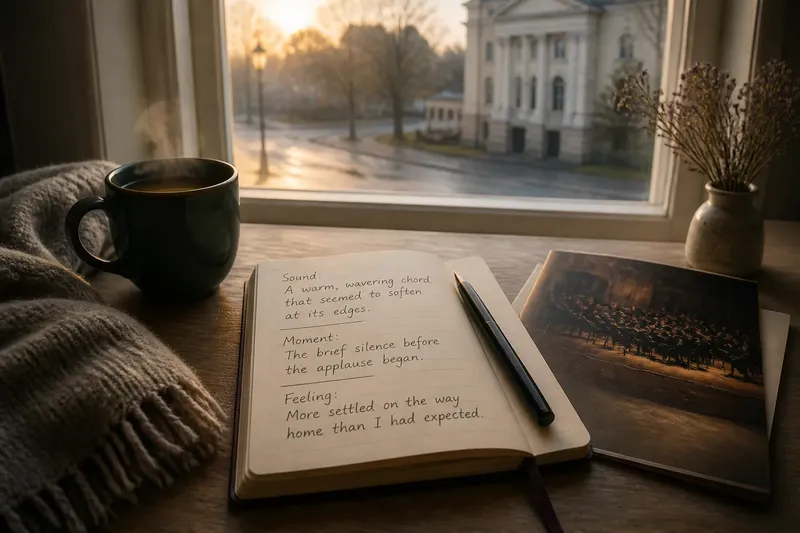
Put the sound, moment and feeling together in three short lines, in that order. You can use sentence fragments if they are clear to you. A compact note might read:
- Sound: A warm, wavering chord that seemed to soften at its edges.
- Moment: The brief silence before the applause began.
- Feeling: More settled on the way home than I had expected.
Keep the wording close to what you actually recall. If a detail is uncertain, say so with a small marker such as “perhaps” or “I think”. That is more honest, and often more useful, than smoothing an uncertain memory into a confident account.
Read the three lines once. Add a piece title or performer’s name only if you want to be able to identify the concert later. Check the programme if necessary, but do not let it turn a brief personal note into a catalogue of works, timings and judgements.
When should I write it?
The next morning is useful because the evening has had time to settle, but there is no strict deadline. If a detail returns later, add it then and leave the original note intact rather than rewriting the memory to sound more complete.
What if I remember very little?
Record the fragment you do have: a texture, a pause, or the feeling of leaving the room. A small honest note can still bring back the shape of the evening; filling gaps with details borrowed from a programme is less helpful.
Should I look at the programme first?
Usually, write your three details before checking it. The programme can help you attach a name to a remembered piece afterwards, while starting with it may pull your attention away from the sounds and moments that surfaced naturally.
How can I keep the note brief?
Give yourself one line for each detail and stop when each line is understandable. You are keeping a personal cue, not writing a review for an audience, so there is no need to explain every reaction or assess the performers.
Leave the note alone
Once the three details are down, close the notebook or note app. You do not need to polish the wording, rate the concert or decide whether your response was the right one. The useful part is the small act of noticing what remained when the rest of the evening had passed.
It is not worth trying to recover every piece, every transition or every detail of the venue. That effort can make a gentle memory exercise feel like homework, and the result may say less about what mattered to you than those first plain observations.
Later, if you come across the note, let it serve as a prompt rather than a verdict. A phrase about a wavering chord may bring back the room, your mood or something you had not thought of that morning. For a quiet morning after the concert, three specific details are enough to keep the door open.