From Folded Leaflet to Concert Programme: A Brief History of the Paper Companion
Concert programme history shows how a paper handout could guide listeners, document an event and preserve its context, while revealing the limits of the printed record.
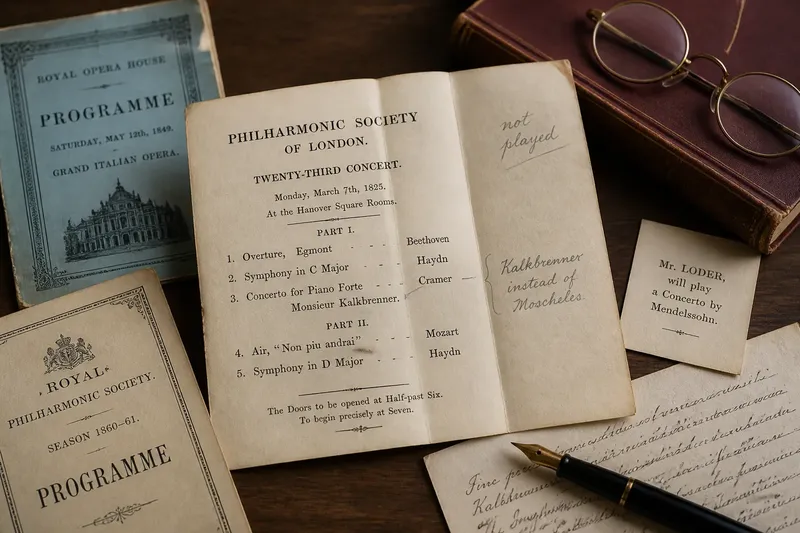
A folded sheet from a London concert in the early nineteenth century might name the evening’s performers and works without offering much explanation. Concert programme history is clearest when read through such specific objects: the printed page records what an organiser announced, while its layout and surviving marks show how audiences were expected to use it.
Programmes did not follow one universal path from plain notice to elaborate booklet. Their contents depended on the event, the venue and the people producing them. A list of titles could orient a listener; a booklet with biographies or notes could also frame how the music was understood.
Notices and programmes
Printed concert notices and handbills circulated in Britain before the mature, bound programme became familiar. London’s eighteenth-century pleasure gardens, including Vauxhall, advertised musical entertainments through printed notices and bills. These materials were designed to announce an event and attract visitors, not necessarily to become a lasting account of every performance.
By the nineteenth century, printed programmes were also used at organised concerts. The surviving documents associated with the Philharmonic Society of London, founded in 1813, offer a concrete institutional example: programmes could set out works and performers for a particular concert. They are useful records of what the society presented on paper, though they do not by themselves establish every change made on the night.
That distinction matters. A programme is evidence of an announced plan, not a complete transcript of an evening. A handwritten alteration or an inserted slip may record a change; without one, a reader should not assume the printed order tells the whole story.
Format and audience
A single sheet can make the essential sequence easy to scan. A folded leaflet or booklet can accommodate more performers, longer works, translations, acknowledgements and explanatory notes. These formats reflect different practical choices, not a simple march towards improvement.
London’s Royal Opera House and concert societies such as the Philharmonic Society have issued programmes for particular occasions and seasons. Their printed material belongs to specific institutions and audiences; it should not be treated as evidence that every concert in Britain used the same format or offered the same detail. The design tells a reader what information the organisation chose to place in the audience’s hands.
More pages can help, but they can also make the basic sequence harder to find. Dense type, ornamental covers and long essays may sit beside a plain list of works and performers. It is not worth the effort to rank programmes by thickness: a concise sheet may answer a listener’s practical questions more directly than a lavish booklet.
Evidence and interpretation
A programme can preserve names, titles, the order as announced, a venue or a season label. As a printed object, it can also show how an organisation presented itself through typography, cover design and acknowledgements. Those details are evidence of the document’s public face, not proof of how every listener responded.
Programme notes require a different reading. A list identifies what was announced; commentary interprets it. Notes may explain a work or offer background, but they remain part of the organiser’s presentation rather than an independent account of the sound in the hall.
Suppose a programme lists a symphony after an interval, while a handwritten note beside it says “not played”. The printed page records the announced plan, and the annotation records a later claim about the event. Keeping both together preserves the difference between those kinds of evidence instead of quietly turning either into certainty.
Reading a programme carefully
- Check whether a date is printed; if it is, record it as printed, but if it is absent, leave the date uncertain rather than supplying one from memory.
- Check the venue name; if it appears, retain it with the programme, but if it does not, do not identify the room by guesswork.
- Check the listed performers against any handwritten amendment; if the names differ, preserve the amendment with the page, but if no amendment appears, describe only the printed names.
- Check the order of works; if a change is marked, note both the printed sequence and the mark, but if there is no mark, call it the announced order rather than the confirmed running order.
- Check for an insert or loose slip; if it alters or adds information, keep it with the programme, but if it has no clear connection, store it separately with a note of the uncertainty.
- Check whether a passage is a work list or programme note; if it explains or praises the music, identify it as commentary, but if it only names works and performers, treat it as event information.
How should old programmes be read?
Can a programme prove what was performed?
It can establish what the organiser printed as the plan, including stated performers and works. It cannot, by itself, confirm that every listed item was performed or that no encore took place.
Why do programme formats differ?
A recital, an opera performance and a society concert have different information to convey. The organiser’s resources, audience and purpose also shape whether the result is a sheet, leaflet or booklet.
Are programme notes reliable sources?
They are reliable evidence of what the programme told its audience, but they are commentary rather than a neutral record of the performance. Separate the note’s interpretation from the printed list of works and performers.
What should stay with a programme?
Keep inserts, marked amendments and other papers that clearly relate to the event. Record visible details such as a venue or season label, and leave gaps open when the document does not answer them.
From keepsake to archive
A programme may survive as a souvenir, but it can also become useful historical evidence. An individual sheet offers limited information; a group of programmes from one institution can make recurring choices easier to see, such as how works were named or how performers were credited. Any interpretation still needs to distinguish what the papers state from what they leave unknown.
Imagine a listener finding a leaflet in a family box. Its cover names a Manchester concert hall, the inside lists a string quartet, and a pencil mark crosses out one player’s name. The listener keeps the mark with the leaflet, transcribes the printed details separately from the annotation, and avoids assigning a date because none appears. The result is a modest but clear record: the event’s venue and announced performers are visible, while the reason for the alteration and the exact date remain unresolved.
Concert programme history is therefore a history of practical paper as well as musical institutions. A programme can guide an audience, present an organisation and preserve part of an event, but its strongest evidence lies in what can be read directly. Treating the printed plan and later marks as distinct keeps the document useful without asking it to reproduce the music it cannot contain.